

The man who talked CMS into turning the luminosity down
Most postdocs leave behind a folder of plots. Jan Eysermans leaves behind a dataset.
Jan joined the PPC on April 1, 2021 and has moved on August 1, 2026 to CERN as an applied fellow. It falls to me to try to summarize in a few paragraphs several years of work that cannot really be summarized, and to extend my big THANK YOU! Jan arrived with a resistive-plate-chamber pedigree, spent his time here at the sharpest end of electroweak precision physics, quietly became the group’s voice on FCC-ee physics, and taught a small army of undergraduates how to plot a dimuon spectrum and so much more. That is a lot of ground for one person.
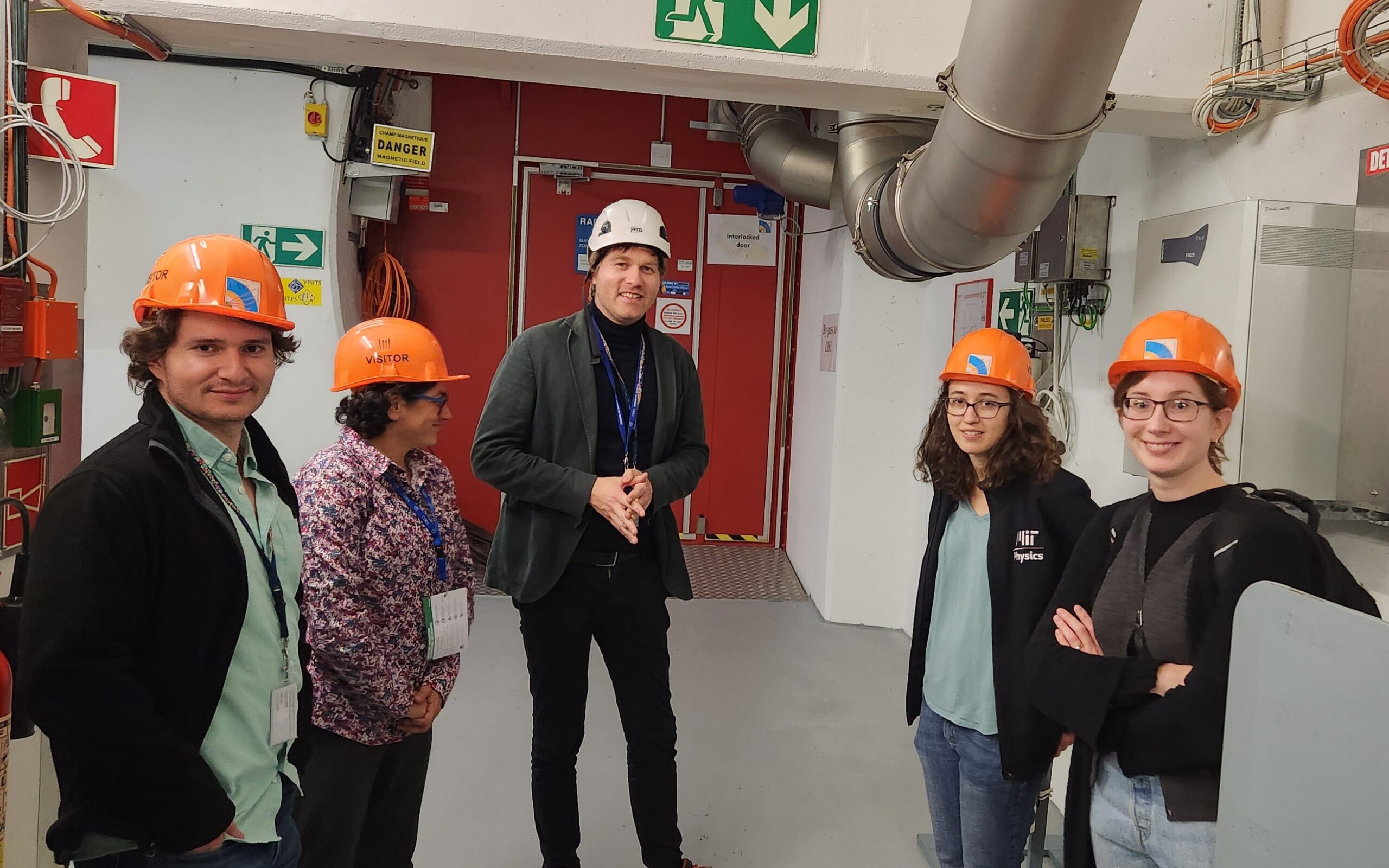

Jan was our spirited guide, 100 m below the surface, when MIT’s Dean of Science came to visit CMS.
From resistive plates to the W boson mass
Jan came to particle physics through hardware. His PhD, completed in 2019 at the Institute of Physics in Puebla, was a search for additional Higgs bosons, but the running thread of those years was the CMS RPC muon system: high-voltage calibration methods, detector control and monitoring, thin double-gap prototypes for high-rate operation, and the long, patient campaign to find eco-friendly gas mixtures that will let these chambers keep working for decades without a greenhouse-gas problem. That work is still appearing in journals today, years after he moved on to other things. People who learn a detector from the gas up tend to make good analyzers later, and Jan is the proof.
The recoil, the transverse mass, and three weeks of low pileup
When Jan joined the W boson mass effort he joined it last, which in an analysis often referred to as the “kiss of death” is not the easy seat. He took on the calibration of the hadronic recoil, a second-order effect entering through the muon isolation criteria and exactly the kind of quiet detail that can spoil a measurement claiming a precision of better than 10 MeV. It did not spoil it. The result was announced in a CMS seminar on 17 September 2024 and published in Nature 652, 321 (2026), one of only a handful of CMS papers ever to appear there, the most precise W mass from any LHC experiment, and the measurement that finally put the CDF puzzle to rest.


Happy MIT faces at the W mass seminar in September 2024.
But the recoil work was never just about that number. It laid the foundation for using the transverse mass, which is how this analysis gets to its next level, and here Jan did something postdocs almost never manage: he changed the running plan of the LHC. Convincing a collaboration of thousands to spend three weeks of a short final Run 3 year deliberately collecting fewer collisions per crossing requires a physics case, patience, and a willingness to say the same thing in twenty meetings. He was the champion of the 2026 low-pileup run, and in June 2026 he stood up in the CMS plenary to report on the physics program built from that dataset. Anyone who does an independent low-pileup W mass measurement in the coming years will be working with data that exists because Jan argued for it.
Along the way he became the group’s regular representative on this program: the low-pileup mW talk at the CMS SMP workshop in September 2025, the low-pileup session at the Pisa Precision EWK workshop in March 2026, and the plenary at CMS Week in June 2026.

Jan taking attendance in Pisa, transporting him back to his days of elementary school.
An FCC-ee physicist before it was fashionable
Long before the European Strategy Group named FCC-ee the preferred next flagship, Jan was already writing the papers that define its Higgs and electroweak program. He is a co-author of the 2021 “special Higgs challenge” study on measuring the Higgs mass and ZH cross section with ultimate precision, and since then a steady stream has followed: the model-independent ZH cross section, precision measurements of Higgs hadronic decay modes, and, this very month, a first-author paper on measuring the Higgs boson mass to a precision comparable with its natural width. That last one is worth pausing on. It is a measurement no existing machine can dream of, and Jan has now written down how to do it.
He also refused to leave the machine-detector interface to somebody else. His work on beam-induced backgrounds and beam-beam effects at FCC-ee, including the De⁺e⁻ffusion generative-model surrogate for incoherent pair creation, addresses an unglamorous bottleneck: the simulations everyone needs are orders of magnitude too expensive to produce. Detector layout choices and DAQ strategies for a collider in the 2040s depend on getting this right.
When the community wanted a summary of where FCC-ee physics stands, it asked Jan. He gave the overall Physics Summary on the final day of FCC Week in Vienna in 2025, and at the Munich FCC Physics Workshop in January 2026 he presented both the electroweak precision program and the background modelling. Two of the hardest talks in the field, back to back.
The invisible work
There is a category of contribution that never shows up on a CV and without which nothing works. Jan wrote for this blog in October 2023 about the Tier-0 running the prompt reconstruction of the heavy-ion run on more than 100 000 CPUs simultaneously, an absolute record, achieved by reaching outside CERN to European Tier-1 sites and the retired Run-2 HLT farm, something CMS had never done before. He is also a co-author of the SubMIT analysis facility paper, the machine our whole group and much of the department now analyzes data on. Records and infrastructure. Both matter.
The January habit
Every January, Jan flew from Geneva to Boston to teach undergraduates how to do physics. He was there for the very first FCC project during IAP 2023, where he prepared the analysis topics, generated the simulations, and wrote the outlines of the analyses the students would attempt, and he kept coming back as the program grew from a vague PR idea into a properly organized school with remote students from Purdue and Maryland. “I was deeply surprised by their enthusiasm and questioning attitude, both of which are essential in our field when unknown physics is being explored,” he said after that first round. Later he wrote here that the trip was always a highlight of his year, and added, correctly, that “plotting and understanding the invariant mass of the dimuon spectrum is always a must.”
The students returned the compliment. After the road trip to the first US FCC workshop at Brookhaven, one of them reported that Jan’s charisma during his presentation was “almost overwhelming, so much so that, at times, we had a hard time paying attention to the actual content.” We have all been in that talk.
That mentoring was not decorative. Katie’s work on realistic beam-induced background simulation, presented at the first TDAQ workshop at CERN and at the APS Global Physics Summit, was led by Jan. Five students from the first January cohort came to CERN for summer research. Several of them are still in the field.
What he leaves behind
A hadronic recoil calibration in a Nature paper. Three weeks of low-pileup collisions that would not exist without him. A blueprint for the Higgs mass measurement at FCC-ee. A generation of undergraduates who know what a Z peak looks like. And a slightly quieter office in January.
Jan is staying with the program though. He continues at CERN as an applied fellow, which means the low-pileup data stays in good hands and that we will keep running into him in Building 40. The PPC’s loss is, at worst, a change of address.
Thank you, Jan! Do not be a stranger, and keep an eye on that recoil!
References
- CMS Collaboration, “High-precision measurement of the W boson mass with the CMS experiment at the LHC”, Nature 652, 321 (2026), arXiv:2412.13872; Nature commentary d41586-026-00630-9; MIT News
- J. Eysermans, A. Li, G. Bernardi, C. Paus, E. Perez, M. Selvaggi, “Toward a Measurement of the Higgs Boson Mass with Natural-Width Precision at FCC-ee”, arXiv:2608.12071
- A. Li, J. Eysermans, G. Bernardi, K. Dewyspelaere, M. Selvaggi, C. Paus, “Model-independent ZH production cross section at FCC-ee”, arXiv:2512.21290
- A. Del Vecchio, J. Eysermans, L. Gouskos, G. Iakovidis, A. Maloizel, G. Marchiori, M. Selvaggi, “Precision measurements of Higgs hadronic decay modes at the FCC-ee”, JHEP 04, 181 (2026), arXiv:2511.23149
- P. Azzurri et al., “A special Higgs challenge: measuring the mass and production cross section with ultimate precision at FCC-ee”, Eur. Phys. J. Plus 137, 23 (2022), arXiv:2106.15438
- A. Chahine et al., “De⁺e⁻ffusion: Capturing the Beam-Beam Physics of e⁺e⁻ Collisions with Diffusion Models”, arXiv:2607.18512
- P. Acosta et al., “SubMIT: A Physics Analysis Facility at MIT”, EPJ Rev. Instrum. 10, 2 (2026), arXiv:2506.01958
- J. Eysermans, “High voltage calibration method for the CMS RPC detector”, JINST 14, C09046 (2019)
- J. Eysermans, “Search for additional Higgs bosons with the CMS detector at the CERN LHC”, PhD thesis, Institute of Physics, Puebla (2019)
- PPC: It’s official – Nature has spoken (2026-04-09), CMS Week in June 2026! (2026-06-12), CMS Precision EWK Workshop (2026-03-10), Momentum builds for FCC at the Munich Physics Workshop (2026-02-03), The PPC and Electroweak Precision Physics (2025-10-07), Vertex Detectors, Beam Backgrounds: Highlights from Our FCC-ee Activities (2025-11-14), FCC Week in Vienna: Building our future (2025-05-27), From CERN to MIT for the FCC Workshop (2025-01-26), by Jan Eysermans